Marcel Breuer
(1902-1981) architect and designer
Luca Perlini · · 2 min read
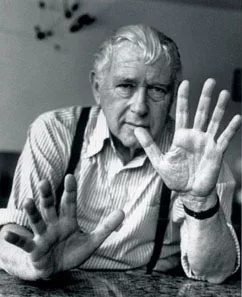
Architect and designer Marcel Breuer was born in Pécs, Hungary, in 1902 and died in New York in 1981.
In the early 1920s he studied at the Bauhaus, in the carpentry workshop. After a short spell in an architecture office in Paris, he returned to the Bauhaus as a teacher and from 1925 to 1928 ran the furniture workshop.
A favourite pupil of Walter Gropius, founder of the Bauhaus, Breuer embodied many of the school's principles and was one of its most famous students.
He began designing modern furniture in tubular steel, including his famous chairs. He designed the furniture for the new Bauhaus building in Dessau (1925-1926) and, in 1927, for Erwin Piscator's flat in Berlin.
From 1935 to 1937 he worked in London with the architect F.R.S. Yorke. In 1937 he moved to the United States, to Harvard University, where he taught architecture at the Graduate School of Design alongside Gropius.
From 1938 to 1941 he was in practice with Walter Gropius. In 1952 he designed the UNESCO headquarters in Paris with Pier Luigi Nervi and Bernard Zehrfuss. In 1956 he founded Marcel Breuer and Associates. Increasingly devoted to architecture, he was one of the great figures of the Modern Movement.
He helped to lay the foundations of a new culture of living. His fame went far beyond the 1920s: he is considered one of the most important designers and interior architects of the twentieth century.
In 1972 he was the first living architect to be given an exhibition at the Metropolitan Museum of Art in New York. The Wassily armchair is named after his Bauhaus colleague Wassily Kandinsky, the Cesca chair after his daughter Francesca.
Among his most significant designs:
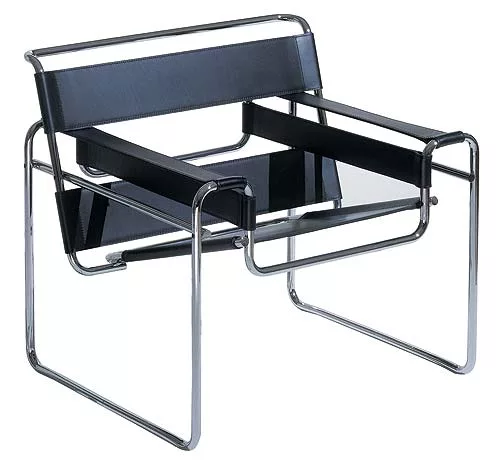
Wassily Chair (1925) - armchair - Knoll
Bent and chrome-plated tubular steel frame; seat, back and armrests in leather.
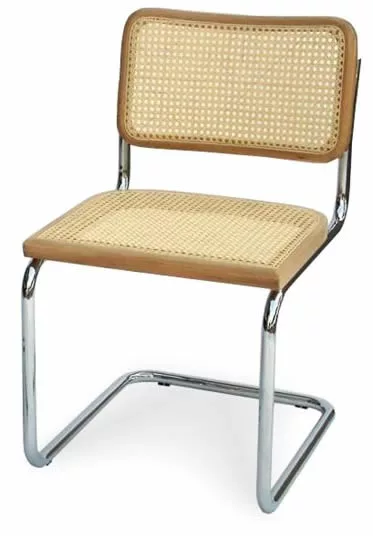
Cesca (1928) - chair - Knoll
25 mm tubular steel frame with chrome finish. The Cesca is available fully upholstered or with a cane seat and back.
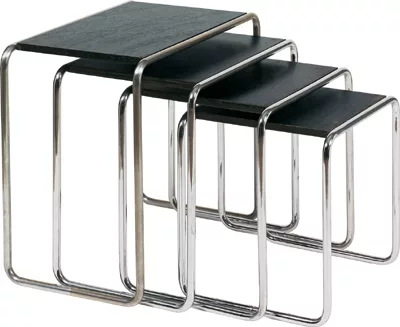
B9 nesting tables (1925-1926) - Thonet
Tubular steel frame and lacquered plywood tops, 60.7 x 66 x 38.7 cm.