Alvar Aalto
(1898-1976) architect and designer
Luca Perlini · · 3 min read
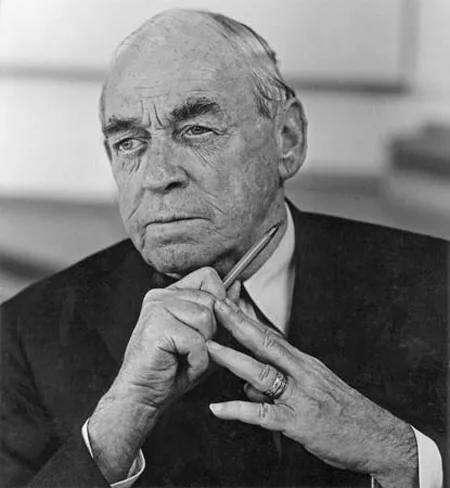
Alvar Aalto was born in Kuortane, Finland, in 1898 and studied architecture at the Helsinki University of Technology from 1916 to 1921. He was a great architect and a designer of furniture, glassware and lamps.
He moved to Jyväskylä, where he opened his architecture practice in 1923. The following year he married the architect Aino Marsio.
The couple spent their honeymoon in Italy: the trip left a deep mark on him, and Mediterranean culture remained a point of reference for the rest of his life.
He began his career designing exhibitions, and in 1925 he started working on furniture. He experimented with laminated wood, bending and gluing plywood: the technique he would use for many of his pieces, including those of the famous Paimio series.
In 1927 he won the competition for the headquarters of the South-West Finland Agricultural Cooperative and moved to Turku. In 1928 he joined the CIAM (Congrès Internationaux d'Architecture Moderne). In 1929 he designed the exhibition for Turku's 700th anniversary and set up an experimental plywood workshop with Otto Korhonen, technical director of a local furniture factory.
In 1933 he completed the tuberculosis sanatorium in Paimio, set in a dense forest about thirty kilometres from Turku. Besides the building, he designed the interiors, furnished with a collection of furniture created for the purpose and named Paimio after the sanatorium.
Aalto's work was a great success in the United Kingdom, where it was shown in London in 1933, and in France, with the Finnish pavilion at the 1937 Paris Exposition.
In 1935, together with Aino Marsio, the arts patron Maire Gullichsen and the art historian Nils-Gustav Hahl, he founded Artek, through which he continued to develop his bent plywood furniture.
In 1936 he built his own house in the Munkkiniemi district of Helsinki, based on a principle that would guide all his work: the natural landscape that hosts a building should determine its character. He applied it successfully to many other buildings, such as the Sunila industrial and residential complex.
In 1939 he designed the Finnish pavilion at the New York World's Fair. After the Second World War he built Baker House, the student dormitory at MIT (Massachusetts Institute of Technology).
In 1957 he received the Royal Gold Medal of the Royal Institute of British Architects (RIBA); in 1958, the year he stepped down as president of the Finnish Association of Architects, he won several competitions.
In the 1960s he built the civic centres of Seinäjoki and Rovaniemi, and in 1963 he became president of the Academy of Finland.
His last project was the university area of Reykjavík, Iceland (1975-1976). He died in Helsinki on 11 May 1976, after a life rich in projects, buildings and honours.
Alvar Aalto is without doubt one of the most important modern architects: starting from rationalism, he went beyond its formal rigidity through his brilliant use of natural materials and his search for a space of undulating lines and surfaces, open plans and a close relationship between building and environment.
Among his most significant design works:
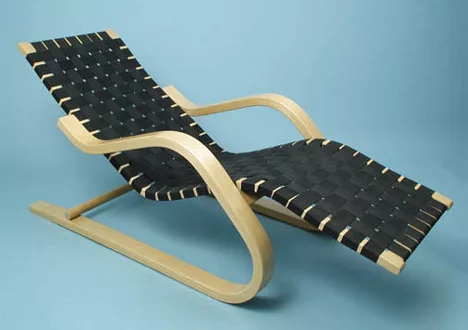
Lounge Chair 43 (1936-1937) - lounge chair - Artek

Armchair 41 "Paimio" (1931-1932) - armchair - Artek
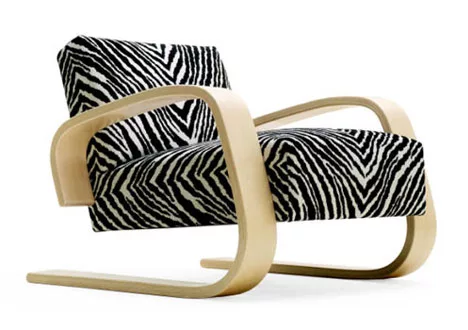
Armchair 400 (1935-1936) - armchair - Artek
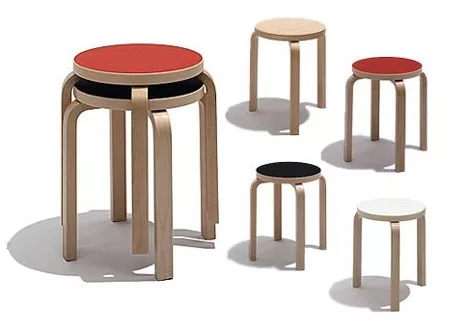
Stool 60 (1932-1933) - stool - Artek
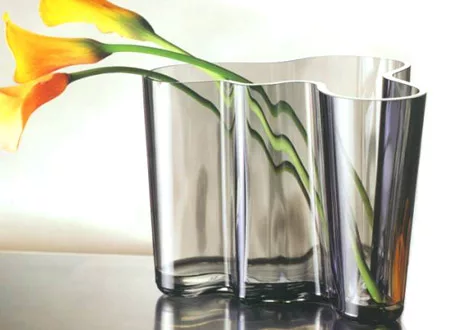
Savoy (1936) - vase - Iittala