Alessandro Mendini
(1931-2019) architect and designer
Luca Perlini · · 3 min read
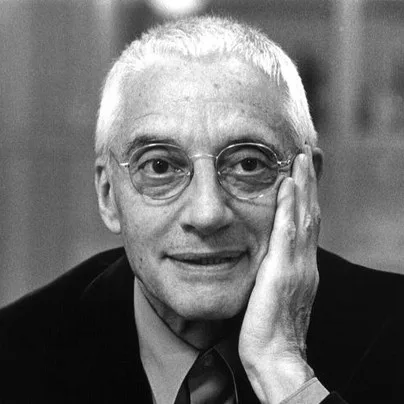
Alessandro Mendini was born in Milan in 1931.
Architecture was not his boyhood dream: he would have liked to be a cartoonist, or perhaps a painter. Nevertheless, in 1959 he graduated in architecture.
His first workplace was the Nizzoli Associati studio.
In 1970 he left architectural practice to devote himself to architecture and design journalism. He edited "Casabella" from 1970 to 1976 and the following year founded "Modo", which he ran until 1979. That same year Gio Ponti entrusted him with the editorship of "Domus".
He always said he saw himself as a designer of magazines, regarding the magazine as a mass-produced object: "an object of industrial design produced in thousands of copies".
These were years of discussion and intense debate on design. Without designing himself, Mendini took part, sometimes as a founder, in all the movements born in that period.
One of them was Global Tools, the radical design school founded in 1973 to bring the most natural and spontaneous creativity back into design, whose members met in the editorial office of "Casabella". In 1979 he received the Compasso d'Oro for his theoretical work.
In those years he also published books collecting his ideas: Paesaggio casalingo (1978), Addio architettura (1981) and Progetto infelice (1983).
At the end of the 1970s he returned to designing furniture and objects. In an interview with Rai Educational he said: "With editing magazines there was a kind of divorce, a clean break, and it's a job I would never do again. At a certain point I wanted to really design".
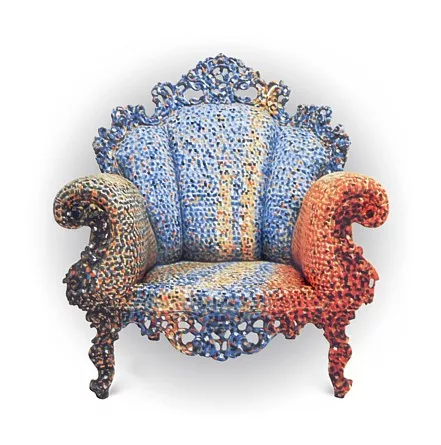
So in 1979 he joined Studio Alchimia, founded in 1976 by Alessandro Guerriero, which created objects for pure artistic pleasure, with references to popular culture and kitsch, outside industrial production and practical use: a challenge to rational design in pursuit of the alchemical dream of turning even the humblest material into something of value. The famous Proust armchair (1978) dates from these years.
With him were, among others, Ettore Sottsass and Michele De Lucchi. In 1981 he received another Compasso d'Oro with Alchimia for its research on decoration. In the same years he also took part in the Bracciodiferro project.
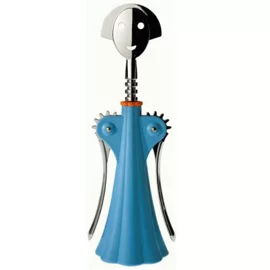
He created objects, furniture, interiors, paintings, installations and buildings. In 1989 he opened Atelier Mendini in Milan with his brother Francesco, designing among other things the Groninger Museum in the Netherlands (1994). For Alessi he designed objects that became icons, such as the Anna G. corkscrew (1994).
Monographs on his work and that of Alchimia have been published in many languages. He was an honorary member of the Bezalel Academy of Arts and Design in Jerusalem, a Chevalier des Arts et des Lettres in France, and was honoured by the Architectural League of New York.
He was professor of design at the Hochschule für angewandte Kunst in Vienna.
He curated exhibitions and seminars in Italy and abroad. His work is held in many museums, including the Museum of Modern Art in New York and the Centre Pompidou in Paris, in the archives of the University of Parma and in the collection of the Gilman Paper Company. In 1989 the museum in Groningen, in the Netherlands, held a major exhibition of his work.
Alessandro Mendini died in Milan in 2019.