Peter Behrens
(1868-1940) designer, architect, graphic designer and artist
Luca Perlini · · 3 min read
Peter Behrens was born in Hamburg in 1868. He studied painting at the Karlsruhe School of Art from 1886 to 1889 and then in Düsseldorf, privately, with Ferdinand Brütt.
In 1890 he visited the Netherlands before settling in Munich.
A member of the Munich Secession, he was among the most radical artists of his generation. In 1897, after a trip to Italy, he was one of the founders of the Vereinigte Werkstätten für Kunst im Handwerk in Munich.
He designed covers for the literary magazines of the writer Otto Julius Bierbaum, such as Die Insel (1899), Der bunte Vogel (1899) and Pan im Busch (1901).
From 1898 he devoted himself to design, and in the following years he took an interest in graphics and typography, creating new typefaces, including the "Behrens-Schrift".
From 1899 to 1903 he worked at the newly founded Darmstadt Artists' Colony, invited by Grand Duke Ernst Ludwig of Hesse.
1901 marked his final move to the applied arts: he gave up painting and began his career as an architect.
In Darmstadt he built his first house, the Behrens House, for the exhibition "Ein Dokument deutscher Kunst", designing everything from the structure to every single piece of furniture.
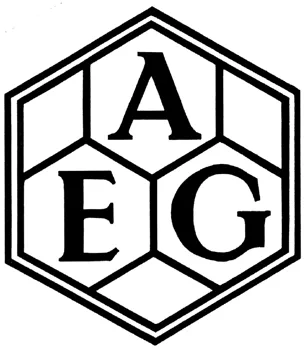
In 1906 he received his first commission for advertising material from AEG, the great Berlin electrical company founded by Emil Rathenau, for which the architect Alfred Messel and the graphic designer Otto Eckmann had already worked.
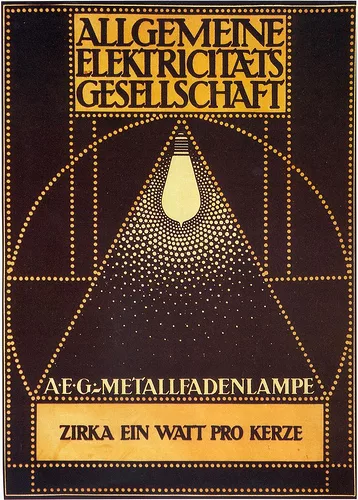
In 1907, called by Paul Jordan, director of the Allgemeine Elektricitäts-Gesellschaft (AEG), he became its architect and artistic consultant, with tasks ranging from letterheads and industrial products to buildings. He stayed with AEG until 1914 and also designed its logo.
From advertising, his work thus extended to the company's entire image: this was the birth of corporate identity, of which Behrens is considered the pioneer.
His long relationship with AEG and the Rathenau family, besides allowing him an exceptionally broad range of work, put him at the forefront of rethinking the role of the architect and designer in modern society.
His Berlin office employed architects who would become masters themselves: Walter Gropius (1883-1969), Adolf Meyer (1881-1929), Le Corbusier (1887-1965) and, for three years, Ludwig Mies van der Rohe (1886-1969).
In 1921 he taught for a year at the Düsseldorf Academy. From 1922 to 1936 he headed the school of architecture at the Academy of Fine Arts in Vienna, and from 1936 until his death the architecture department of the Prussian Academy of Arts in Berlin.
He died in Berlin on 27 February 1940.
In moving from painting to design and architecture, Behrens evolved from the classical language on which he had based his idea of industrial culture to expressionism and finally, in his last works, to rationalism.
His main architectural works include:
- Behrens House (Darmstadt, 1901)
- AEG Turbine Factory (Berlin, 1909)
- Mannesmann offices (Düsseldorf, 1912)
- Hoechst administration building (Frankfurt, 1920-1924)
- Gutehoffnungshütte warehouse (Oberhausen, 1921-1925)
- Alexanderhaus and Berolinahaus on Alexanderplatz (Berlin, 1929-1932)
- Tobacco factory (Linz, 1929-1935)